Karma yoga in the Bhagavad Gita: acting without clinging to results
What the Gita means by working without attachment to results, read through four key verses and the commentators who shaped them.

On this page
In brief
- 1Karma yoga means acting fully while letting go of the anxious grip on outcomes; it is not withdrawal from work.
- 2Gita 2.47 and 2.48 frame it: your claim is on the action, and evenness in success and failure is yoga.
- 3Shankara, Ramanuja, Gandhi and Tilak agree that clinging to results binds, but differ on what selfless action finally achieves.
If you know one line of the Bhagavad Gita, it is probably this one: your right is to the work, never to its fruits. The line is easy to quote and just as easy to misread, as if it told us not to care how things turn out.4
Read in its setting, it asks for something more demanding and more humane. It describes a way of acting fully while loosening the anxious grip on outcomes. The Gita calls this karma yoga, the discipline of action.
Where the teaching is given
The Gita did not begin as a separate book. It is an episode near the start of the sixth book of the Mahabharata, the Bhishma Parva, which goes on to describe the first ten days of the great war. Britannica places the Gita at chapters 23 to 40 of that book.3
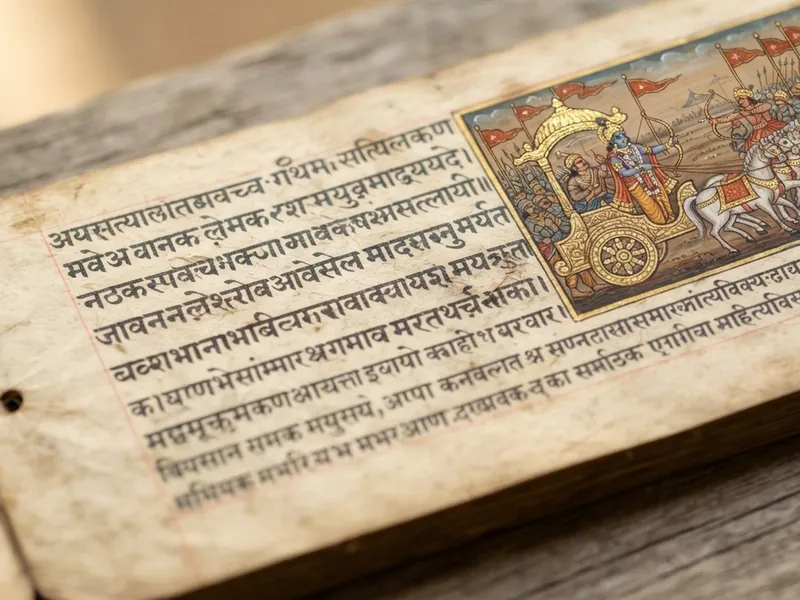
Its first verse sets the scene on the field of Kurukshetra, where the blind king Dhritarashtra asks his minister Sanjaya what the two assembled armies did. Arjuna, the Pandava archer, sees teachers, elders and cousins drawn up on the other side and loses the will to fight. His charioteer Krishna answers him over eighteen chapters.
Modern scholars generally date the Gita to around the start of the Common Era; Britannica suggests perhaps the first or second century CE. Many within the tradition regard it as far older, as old as the events it describes. The teaching reads the same on either view.
Three words help. Karma here means action or work, not only its moral consequences. Phala, fruit, is the result an action yields. Sanga is attachment: the clinging that makes us act for the sake of a result and suffer when it does not arrive.
Four verses at the heart of it
Your claim is on the work alone, never on what it yields. Do not let the fruit of action be your motive, and do not let yourself cling to doing nothing.
The verse makes four moves in two lines. Your sphere is the action. The result is not yours to command. The result should not become your reason for acting. And you should not swing to the opposite extreme of doing nothing, a clause that is easily missed. The Gita has little patience for withdrawal dressed up as detachment.
Steady in yoga, Dhananjaya, do your work and let attachment go. Be the same in success and in failure. This evenness is what is called yoga.
Here the Gita offers one of its own definitions of yoga: samatva, evenness of mind. Krishna does not ask Arjuna (addressed as Dhananjaya, one of his names) to stop caring whether things go well. He asks him to act from a steady place, so that success does not inflate him and failure does not break him.
So, free of attachment, keep doing the work that is yours to do. A person who acts without attachment reaches the highest.
The third chapter returns to the point and adds a promise: unattached action is itself a path to the highest. A few verses earlier (3.8) Krishna says plainly that action is better than inaction, since without it even the body cannot be kept going. The letting go the Gita asks for is inward, not a retreat from work.
The one from whom all beings come forth, by whom all this is pervaded: worshipping that one through one's own work, a person reaches fulfilment.
Near the close, the teaching widens. One's own work, svakarma, offered to the source of all beings, becomes worship. In context the verse follows a passage on the duties of different groups in society; many modern readers take it more broadly, to mean that any honest work, done in the right spirit, can be an offering.
How commentators have read it
The verses are shared, but the emphasis is not. Classical and modern commentators agree that clinging to results binds us. They differ on what unattached action finally achieves.
- Shankara (Advaita Vedanta)
- Selfless action purifies the mind and prepares it for knowledge of the Self, but liberation comes through that knowledge, which on his reading points beyond action towards renunciation.
- Ramanuja (Vishishtadvaita)
- Work done without desire for its fruit, and without seeing oneself as its sole doer, becomes worship of the Lord and is itself a means to liberation, flowing into devotion.
- Mahatma Gandhi, Anasaktiyoga
- In his Gujarati translation, whose introduction he finished in June 1929, Gandhi called renunciation of the fruits of action the centre of the Gita, while insisting it never means indifference to results.
These readings come from different schools and need not be ranked. Many families follow the commentary of their own sampradaya (lineage). The Gita Supersite, run from IIT Kanpur, lets readers compare classical commentaries and translations verse by verse.
Bringing it into working life
For most readers, the battlefield is a desk, a shop floor, a classroom or a kitchen. The Gita's teaching carries over with little strain. A few simple ways to practise it:
- Before a task, name what is actually yours to do: the preparation, the effort, the honesty of the work. Write that down, rather than the outcome you are hoping for.
- Plan for results, then release them. Gandhi's point holds: letting go of the fruit is not the same as not caring how things turn out.
- Notice avoidance. Verse 2.47 warns against attachment to inaction, so the task you keep postponing is part of the practice.
- After a success or a setback, pause before reacting. Ask what can be learnt, and let praise or blame pass through rather than settle.
- Once a day, inwardly offer one ordinary piece of work to whatever you hold highest, in the spirit of 18.46.
None of this asks you to become passive or to stop striving. It asks you to put your effort where you actually have a say, and to meet whatever comes with a steadier mind. That evenness, Krishna tells Arjuna, is what yoga is.
Questions
Common questions
Does karma yoga mean I should not care about results?
No. The Gita asks you not to make the result your motive or your master. You can still plan carefully and want things to go well; Gandhi stressed that renouncing the fruit is not indifference to it.
Do I need to give up work or family life to practise it?
No. The teaching is given to a warrior about to do his duty, and Gita 3.8 says action is better than inaction. The letting go is inward and can be practised in any honest work.
Which commentary should I read on these verses?
It depends on your tradition and interest. Shankara's and Ramanuja's readings differ in emphasis, and Gandhi's Anasaktiyoga and Tilak's Gita Rahasya bring modern concerns. The Gita Supersite lets you compare several translations and commentaries side by side.
Sources
Where this comes from
- Gita Supersite, IIT Kanpur (legacy site)Srimad Bhagavad Gita: verses 1.1, 2.47, 2.48, 3.8, 3.19, 18.46 (Sanskrit, transliteration, Gambhirananda and Sivananda translations, Ramanuja commentary tr. Adidevananda)old.gitasupersite.in
- Encyclopaedia BritannicaBhagavadgitabritannica.com
- Internet Sacred Text ArchiveThe Mahabharata, Book 6: Bhishma Parva (tr. Kisari Mohan Ganguli)sacred-texts.com
- Internet Encyclopedia of PhilosophyBhagavad Gitaiep.utm.edu
- mkgandhi.org / NavajivanThe Gospel of Selfless Action, or The Gita According to Gandhi (Mahadev Desai, incl. Gandhi's Anasaktiyoga introduction)mkgandhi.org
- Embassy of India, YangonScreening of Movie on Lokmanya Bal Gangadhar Tilak (note on Gita Rahasya written in Mandalay)embassyofindiayangon.gov.in
We write from the texts and references listed above, in plain English. Customs vary between regions, communities and families. Where your family has its own practice, follow it, or ask your family priest.
Take it further
Bring the Gita to your own questionWrite to a Vedic consultant about a decision or a difficulty, and receive guidance read against the scriptures.
Spiritual consultation Keep reading