Sharad Navratri: the nine nights, Navadurga and Vijayadashami
What the nine autumn nights honour, the nine forms of Durga, how Bengal, Gujarat and the South keep them, and the 2026 dates for New Delhi.

On this page
In brief
- 1Sharad Navratri runs from Pratipada to Navami of Ashvin's bright half, and the tenth day is Vijayadashami (Dussehra).
- 2Each night honours one of the Navadurga, from Shailaputri to Siddhidatri, beginning with Ghatasthapana on the first morning.
- 3In 2026 (New Delhi) Navratri began on 11 October, Ashtami and Navami fall together on 19 October, and Dussehra is on 20 October.
Navratri means "nine nights". Of the several Navratris in the Hindu year, the one kept in autumn, Sharad or Shardiya Navratri, is the most widely observed, which is why it is also called Maha Navratri. It runs through the bright half of the lunar month of Ashvin, from Pratipada (the first lunar day) to Navami (the ninth), and the tenth day is Vijayadashami, better known as Dussehra.13
The nine nights belong to the Goddess. Families keep them with fasting, scripture, song, dance and home shrines, in ways that vary greatly from region to region.
The story behind the nine nights
The festival draws on the Devi Mahatmya, a Sanskrit hymn of praise to the Goddess, also known as the Durga Saptashati or Chandi Path, which many households recite during these days. It tells of Durga's battles with demons who had driven the gods from heaven, above all Mahishasura, the buffalo demon. Her victory over him is remembered on the tenth day.
One of the best-loved passages is a hymn the gods sing to the Goddess. Each verse begins by naming a quality in which she lives in every being, such as consciousness, forgiveness or strength, and ends with the same threefold bow.
To the Goddess who dwells in all beings as power: salutations to her, salutations to her, salutations to her, again and again.
In North India the same season also belongs to Rama. Across the region, the Ramlila, a staged retelling of the Ramayana, plays night after night and ends on Dussehra with the burning of Ravana's effigy.
Ghatasthapana: how the nine nights begin
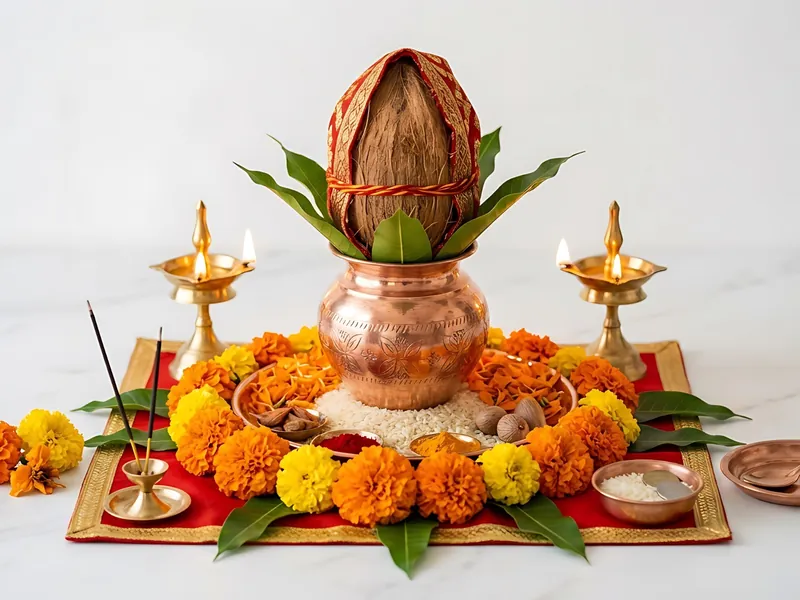
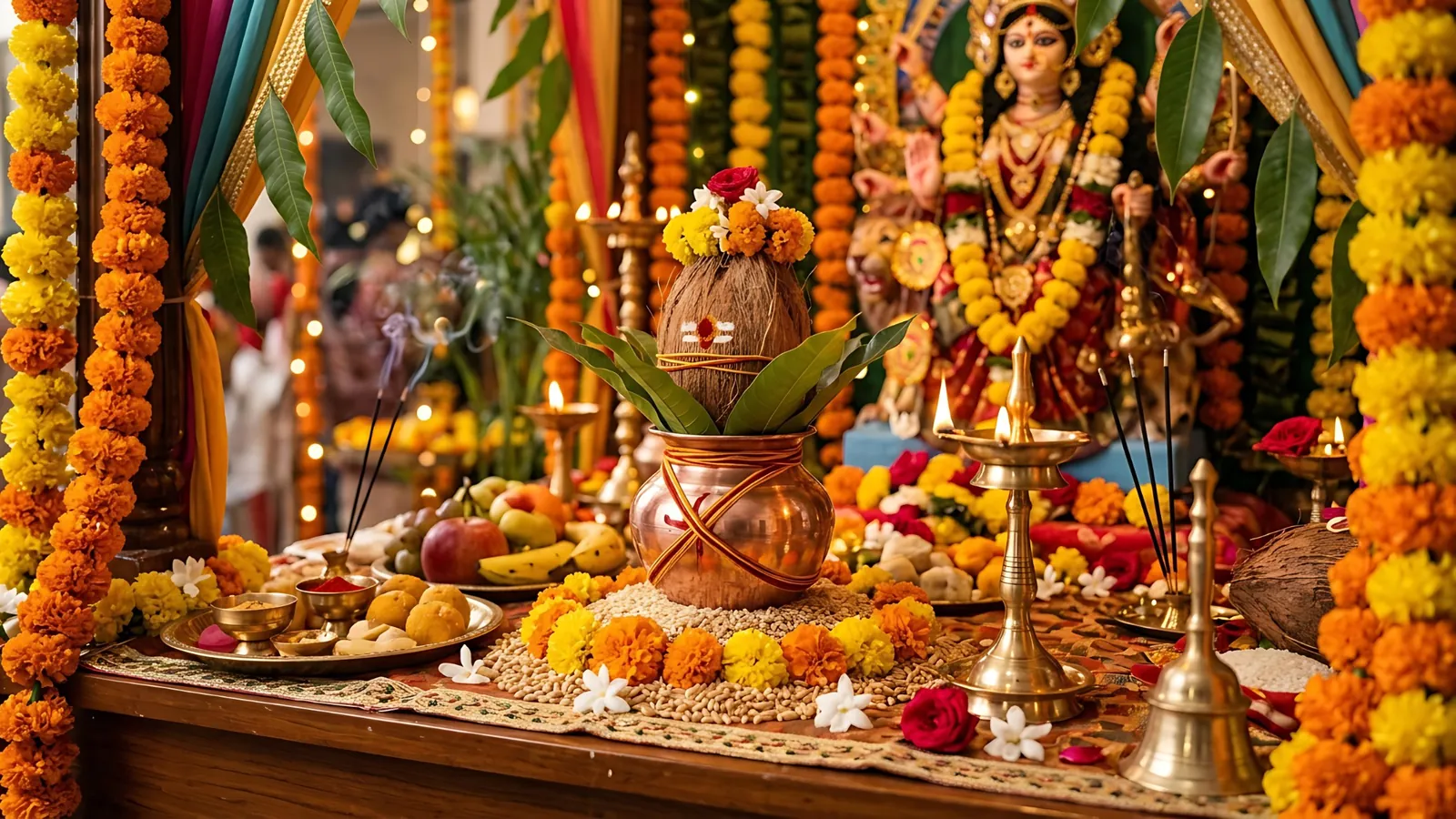
Navratri opens with Ghatasthapana, also called Kalash Sthapana, the setting up of a sacred pot. A clay or metal pot is filled with water, crowned with mango leaves and a coconut, and placed on a small bed of soil in which grain is sown. The pot stands for the Goddess's presence in the home for the nine days, and the sprouting grain is tended until the festival ends.4
Panchangs (Hindu almanacs) set a muhurta (an auspicious time window) for this rite. It is done in the morning while Pratipada lasts, never at night, with the midday Abhijit muhurta as the usual fallback.
The nine forms of Durga
Each night is linked to one of the Navadurga, the nine forms of the Goddess, worshipped in a fixed order. Together they trace a path from the mountain's daughter to the giver of spiritual attainment.
- Day 1 · Shailaputri
- Daughter of the mountain king Himavat; the Goddess as Parvati, reborn after Sati.
- Day 2 · Brahmacharini
- The Goddess in austerity, the ascetic who undertakes penance.
- Day 3 · Chandraghanta
- Named for the bell-shaped crescent moon on her brow; a form of calm courage.
- Day 4 · Kushmanda
- Linked to the sun and to the first light of creation.
- Day 5 · Skandamata
- Mother of Skanda (Kartikeya), often shown with the child on her lap.
- Day 6 · Katyayani
- The warrior form who goes out to face Mahishasura.
- Day 7 · Kalaratri
- The fiercest form, dark as night, who destroys what is harmful.
- Day 8 · Mahagauri
- Radiant and fair, a form of purity and peace; honoured on Durga Ashtami.
- Day 9 · Siddhidatri
- Giver of siddhi (spiritual accomplishment), worshipped on Maha Navami.
Lunar days do not line up neatly with calendar days. In 2026, at New Delhi, Saptami (the seventh lunar day) is current at sunrise on both 17 and 18 October, so Durga Ashtami and Maha Navami are both kept on 19 October. Popular calendars still assign one form to each date from 11 to 19 October.2
How India keeps Navratri
Bengal: Durga Puja
In Bengal, Odisha, Assam and among Bengali communities everywhere, the season is Durga Puja. The main days run from Shashthi, the sixth lunar day, when the Goddess is formally invited, through Saptami, Ashtami and Navami to Dashami. Clay images of Durga and her children are installed in pandals (temporary pavilions), and whole cities walk from one to the next.
Ashtami brings Kumari Puja, the worship of a young girl as the Goddess, and Sandhi Puja at the meeting point of Ashtami and Navami. On Dashami married women smear vermilion on the image and on one another, and the images are carried to the river for immersion. UNESCO added Durga Puja in Kolkata to its list of intangible cultural heritage in 2021.5
Gujarat: garba and dandiya
In Gujarat the nights belong to garba. Dancers circle a garbo, a perforated earthen pot with a lamp inside, or an image of the Goddess Amba, moving anticlockwise with clapping and song. The circle starts slowly and gathers speed. Dandiya raas, danced with pairs of painted sticks, often follows. UNESCO inscribed the Garba of Gujarat in 2023.6
South India: Golu
In Tamil Nadu, Andhra Pradesh, Telangana and Karnataka, families build Golu (Bommai Golu in Tamil, Bommala Koluvu in Telugu, Gombe Habba in Kannada), a display of dolls on an odd number of steps. Deities sit at the top, saints below them and scenes of everyday life on the lower tiers. Friends are invited in the evenings to see the display, sing and share prasad.7
The last three nights are given to Saraswati, and on Navami many homes and workplaces keep Ayudha Puja, honouring tools, books and instruments. On Vijayadashami a doll is symbolically laid to rest and the display is packed away for another year.
North India: Kanya puja
Across the North, many families close their fast with Kanya puja, also called kanjak, on Ashtami or Navami. Young girls are welcomed as forms of the Goddess, their feet are washed, and they are served a meal, often puri, sooji halwa and black chana, before receiving small gifts.
Vijayadashami: the tenth day
Vijayadashami means "the tenth day of victory". It recalls both Durga's triumph over Mahishasura and Rama's over Ravana, and it is also called Dussehra or Dasara, and Dashain in Nepal. Traditional rites include Shami Puja (worship of the shami tree), Aparajita Puja and simollanghana, symbolically crossing a boundary, done in the afternoon. In Bengal it is the day of immersion and farewell.
Sharad Navratri 2026: dates for New Delhi
- GhatasthapanaSunday 11 October. Muhurta 6:19 to 10:12 am; Abhijit muhurta 11:44 am to 12:31 pm.
- Durga Ashtami and Maha NavamiMonday 19 October. Sandhi Puja 10:27 to 11:15 am.
- Vijayadashami (Dussehra)Tuesday 20 October. Vijay muhurta 1:59 to 2:45 pm.
- Bengal Vijayadashami and Durga immersionWednesday 21 October.
These times follow Drik Panchang for New Delhi and shift with local sunrise; Bengali, Odia and South Indian almanacs may place some days differently.
A simple way to keep it at home
- Set up a kalash on the first morning in a clean corner, and keep a small lamp lit there each evening.
- Read a chapter of the Devi Mahatmya, or simply repeat the verse above, at the same time each day.
- If you fast, choose a pattern that suits your health, and break it on Navami or Dashami as your family does.
- On Ashtami or Navami, honour the girls in your family or neighbourhood with a meal and a small gift.
Questions
Common questions
Why are Durga Ashtami and Maha Navami on the same day in 2026?
Festival days follow the lunar day current at sunrise. In 2026 at New Delhi, Saptami covers sunrise on both 17 and 18 October, Ashtami covers sunrise on 19 October and ends late that morning, and Navami begins then. So Ashtami and Navami rites are both kept on 19 October, with Dussehra on 20 October.
Is Durga Puja the same as Navratri?
They fall in the same fortnight and honour the same Goddess, but they are kept differently. Navratri usually spans all nine nights from Ghatasthapana, while Bengali Durga Puja centres on the five days from Shashthi to Dashami, with clay images in pandals and immersion on the last day.
When should Kanya puja be done?
Most families do it on Ashtami or Navami, according to their own custom. Some honour girls on every day of Navratri.
Sources
Where this comes from
- Drik Panchang2026 Shardiya Navratri Calendar for New Delhi, NCT, Indiadrikpanchang.com
- Drik Panchang2026 Durga Puja Calendar for New Delhi, NCT, Indiadrikpanchang.com
- Drik Panchang2026 Vijayadashami, Dussehra date and Puja time for New Delhidrikpanchang.com
- International Business Times India (Nisha Rao, 4 Oct 2026)Navratri 2026: Date, Ghatasthapana Muhurat, 9 days, colours, puja timings and significanceibtimes.co.in
- UNESCO Intangible Cultural HeritageDurga Puja in Kolkataich.unesco.org
- UNESCO Intangible Cultural HeritageGarba of Gujaratich.unesco.org
- BiblioAsia, National Library Board Singapore (Anasuya Soundararajan, 2019)Navaratri Golu: The Hindu Festival of Dollsbiblioasia.nlb.gov.sg
We write from the texts and references listed above, in plain English. Customs vary between regions, communities and families. Where your family has its own practice, follow it, or ask your family priest.
Take it further
A Navratri puja in your nameOur learned pandits perform pujas through the festival year with a sankalp spoken in your name, and send you the full video.
See puja on your behalf Keep reading